

We conduct and facilitate research to develop sustainable building solutions and promote the adoption of cutting-edge technologies. Research is always industry informed and findings are published here on our website. The Green Hub innovation centre, funded by Wexford County Council and Enterprise Ireland, offers opportunities for SMEs to connect with fellow innovators and develop new products and solutions for addressing climate change within the built environment.
We understand that there is a lot of information out there for companies to access, so we have positioned ourselves as the first port of call for information on sustainable building solutions, linking to useful websites below.
If you would like to feature on our website, please get in touch at info@hpba.ie

Circular Transition Indicators (CTI) for Buildings – Sector Guidance
The built environment is one of the largest contributors to global environmental challenges. It is responsible for nearly 40% of global CO2 emissions, with material extraction, production and disposal driving resource depletion at an unsustainable rate. Buildings account for 50% of global material use, yet only 10% of materials re-enter the economy after demolition. At the same time, regulatory pressures, investor expectations and market demand for sustainable and circular business models are accelerating.
Developed in partnership with Arup and Arcadis and in consultation with an extensive stakeholder group, the CTI for Buildings guidance introduces a lifecycle-based approach for companies in the sector to understand and improve the circular performance of their buildings and projects, supporting internal decision making and initiating value chain collaboration.
Building on WBCSD’s globally recognized Circular Transition Indicators (CTI), CTI for Buildings adopts an extensive list of metrics that helps companies:
- Set circularity roadmaps and measurable targets;
- Track progress on sustainability goals and enhance regulatory compliance;
- Reduce up to 96% of embodied carbon emissions by 2050;
- Boost investor confidence and offer a competitive advantage.
Seize this opportunity to drive your business toward a resource-efficient, low-carbon and regenerative built environment.
Download the guide here: Circular Transition Indicators (CTI) for Buildings – Sector Guidance | WBCSD
Southend Retrofit Project
Southend Retrofit Project
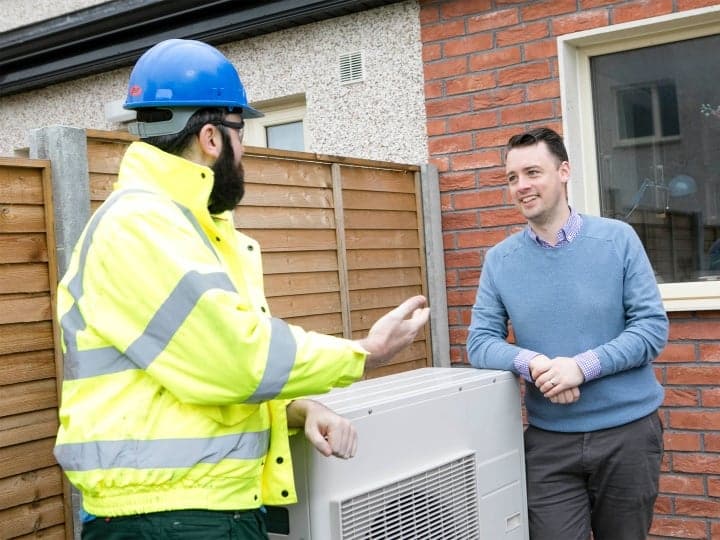
The Wexford Homes project in Southend, Wexford, demonstrates a community-led approach to retrofitting, significantly improving health, wellbeing, and energy efficiency in fuel-poor households. Spearheaded by the Wexford Town Sustainable Energy Community (SEC), Wexford County Council and partners including Southend FRC and HPBA, this initiative replaced outdated back boilers with modern systems like heat pumps, fostering a just transition to sustainability.
Project Background
Formed in December 2021, the SEC conducted a Southend Home Energy Survey revealing widespread reliance on back boilers and lack of central heating, exacerbating fuel poverty. An Energy Steering Group launched in September 2022 united Wexford County Council, SEAI, SETU, the Department of Health, and HPBA to drive retrofits under the Warmer Homes Scheme. Local events in November 2022 and May 2024 promoted grants, while a trusted energy champion from Southend Family Resource Centre (SFRC)—appointed in February 2023—guided residents through applications and behavioral changes.
Key Challenges
Many homes suffered from energy inefficiency tied to obsolete heating, contributing to dampness and health issues in a vulnerable community. Coordinating multi-stakeholder efforts and securing diverse funding streams required strong collaboration. Building trust for intrusive retrofits in tight-knit neighbourhoods demanded relatable local advocates.
Solutions and Implementation
Over 25 homes received upgrades, including heat pumps, supported by SEAI grants and community events for education. SETU’s co-designed research employed surveys, interviews, focus groups, and temperature sensors to evaluate impacts on health and wellbeing. The energy champion’s role—2 hours weekly under Sláintecare—proved pivotal, demystifying processes and ensuring post-retrofit success through trusted, on-the-ground support. To date over 200 individuals have received support.
Results and Impact
Feedback highlights warmer, healthier homes with reduced fuel costs, directly linking retrofits to improved wellbeing. Positive experiences stem from the champion’s explanations and partnerships, validating the model for replication elsewhere. HPBA presented the model to the UNECE Group of Experts on Energy Efficiency in 2024, identifying the importance of expertise in sustainable building alliances, blending technical upgrades with community empowerment for lasting change.
Click here to read the Southend Retrofit Project Report
The pilot is also featured in NESC Report No.36, published May 2025
IntelliMat Project

IntelliMat Project
The IntelliMat Project transforms modular commercial interiors by embedding real-time spatial tracking into the Arcology System—a modular, adaptable interior framework built like a Meccano set around a ceiling-mounted SmartGrid and digital platform. This Design for Manufacturing and Assembly (DfMA) system enables spaces to adapt without waste.
Each year, over 42 million tonnes of EU construction and demolition waste come from non-structural interior works, largely due to inefficient fit-outs and strip-outs. IntelliMat addresses this by integrating Bluetooth 5.3/6 receivers and 5G-connected anchors into factory-assembled walls, ceilings, and services. This creates a live spatial network that continuously maps component positions, turning interiors into material banks. Every module gains a unique digital identity, enabling it to be traced, reused, or traded between buildings. This supports circular construction, digital facility anagement, and scalable reuse across the built environment.
For further information see here: IntelliMat Project
Gorey Market House Renovation Project

Gorey Market House Renovation Project
2025 marked a defining chapter in the story of THRIVE Gorey Market House, which is one of the most ambitious, community-rooted projects ever undertaken in the town, headed by Wexford County Council. What started as a shared aspiration to breathe new life into one of Gorey’s most historic buildings has grown into a movement shaped by local voices, strengthened by strong partnerships between the local authority and the community, and has gained recognition across Ireland and Europe.
Aims & Objectives
- Restore and protect Gorey’s Market House, reinstating its role as a cultural and historical landmark while incorporating the adjacent historic graveyard.
- Develop a thriving town centre with a blend of markets, community function rooms, a concert venue, and multi-purpose spaces.
- Enhance public spaces, making Gorey a more attractive place to live, work, and visit while boosting both the daytime and nighttime economy.
- Create an inclusive, affordable, and sustainable community facility that aligns with principles of equality, environmental responsibility, and carbon reduction.
- Improve town centre connectivity by prioritising pedestrian and cyclist access, including cycling infrastructure and mobility scooter charging points.
- Establish a high-quality, universally accessible public space linked to Gorey’s broader network of green areas, fostering social interaction and well-being.
- Promote biodiversity and green infrastructure through designated biodiversity zones within the plaza.
- Strengthen Gorey’s appeal as a hub for employment, retail, cultural, and recreational activities.
- Unlock a key redevelopment site in the town centre, generating new community and economic opportunities.
- Ensure the goals and recommendations of the project under the New European Bauhaus Values and Principles in being Transformative and Encouraging a Cultural Shift to Sustainable Place-Based Living are achieved.
- Enrich Gorey’s cultural landscape with enhanced facilities and public programming.
- Foster a sense of pride and identity within the community.
The redevelopment of the Market House is now far more than a story of the restoration of a building. For many, it symbolises the spirit of Gorey itself, a town built on connection, creativity and community pride. Now, as the project approaches its most exciting phase yet, that sense of shared purpose feels stronger than ever.
Click here to read the full story: Gorey Market House Renovation Project

Global Status Report for Buildings and Construction 2025–2026

The Global Status Report for Buildings and Construction 2025–2026 is officially launched.
Published by UNEP and GlobalABC, this 10th edition tracks progress across the buildings and construction sector. The buildings and construction sector now accounts for nearly 50% of global material extraction, 37% of global emissions, and 28% of global energy consumption.
The sector is building more floor area without a proportional rise in emissions, thanks to improved energy efficiency. But a decade of tracking through the Global Buildings Climate Tracker shows the gap to meet the Paris Agreement goals is widening, not shrinking.
Decarbonisation has stalled. Construction is outpacing the green transition, renovation rates remain too slow, and fossil fuel dependence persists.
Key Findings
- In 2024, the global buildings floor area expanded by 1.7 per cent, reaching 273 billion square metres.
- The world builds an estimated 12.7 million square metres of floor area –roughly the equivalent of adding the entire city of Paris in new floor space nearly every week.
- Global building energy intensity has reduced by 8.5 per cent since 2015.
- Green building certifications have nearly tripled.
- In 2024, renewables supplied just 17.3% of buildings’ energy demand, far below what is needed for a net-zero pathway.
- Investment in energy efficiency reached USD 275 billion in 2024, contributing to cumulative investment of USD 2.3 trillion since 2015.
Click here to read the full report: Global Status Report for Buildings and Construction 2025–2026
Click here to read the press release: Climate action key to affordable housing, but buildings decarbonisation stalls
Click here to view the previous publications
UNECE - Sustainable Energy

UNECE – Sustainable Energy
UNECE’s work on sustainable energy is designed to improve access to affordable and clean energy for all and help reduce greenhouse gas emissions and the carbon footprint of the energy sector in the region. It promotes international policy dialogue and cooperation among governments, energy industries and other stakeholders. The focus is on energy efficiency, cleaner electricity production from fossil fuels, renewable energy, coal mine methane, gas, classification of energy and mineral reserves and resources, and energy security.
Click here to learn more about: UNECE Sustainable Energy
Click here to browse: UNECE Sustainable Energy Publications
World Economic Forum - Transforming Energy Demand 2024

World Economic Forum – Transforming Energy Demand 2024
In this paper, the Transforming Energy Demand initiative outlines actions for businesses and countries to enhance energy management, efficiency and carbon intensity reduction. It highlights commercially beneficial levers, implementable with existing technologies, to impact the transition significantly.
Adopting measures for energy-efficient output and service delivery is essential for businesses and countries to sustain economic growth and achieve net-zero goals.
As the global population and energy demand rise, particularly in developing markets, implementing public policies and fostering value chain collaborations are key to managing energy consumption and reducing carbon intensity. This will help mitigate energy costs and supply issues and unlock commercial benefits, thereby accelerating the transition. At COP28, over 120 countries committed to doubling the pace of energy efficiency improvement, necessitating concrete, realistic plans.
Click here for the full paper: World Economic Forum – Transforming Energy Demand 2024
Construct Innovate

Construct Innovate
Construct Innovate is Ireland’s National Research Centre for Construction Technology and Innovation, in partnership between Trinity College Dublin, University College Dublin, University College Cork, the Irish Green Building Council, hosted by University of Galway.
With a vision to make Ireland a global leader for sustainable construction and built environment technology, they bring together 23 multidisciplinary research groups across their partner institutions – or over 300 researchers.
Their team has a strong track record in research and innovation with expertise in digital adoption, modern methods of construction, and sustainability. They work together under the five pillars of:
- Productivity, affordability & cost
- Quality & safety
- Sustainability
- Skills & training
- Collaboration
Click here to learn more: Construct Innovate
IMR | Irish Manufacturing Research

IMR | Irish Manufacturing Research
IMR is a not-for-profit, industry-led Research & Technology Organisation. Engineers, researchers, makers and mentors who believe progress should be both practical and human. From labs in Dublin and pilot lines in Mullingar, they partner with organisations across sectors to turn complexity into clarity and ambition into action.
Since 2014, IMR has grown from small pilot centres into a national home for applied innovation. What’s remained constant is how they work: by listening first, focusing on evidence, and moving forward step by step. They know that transformation is rarely about technology alone — it’s about empowering people, reducing risk, and proving value in ways that last.
Click here to learn more: IMR | Irish Manufacturing Research
IGBC | Irish Green Building Council

IGBC | Irish Green Building Council
The Irish Green Building Council – IGBC, is a membership non-profit organisation that was launched in 2011 with organisations and businesses from across the value chain of the built environment. These include architects, engineers, contractors, universities, professional institutes, NGOs, local authorities, energy companies, leading national and transnational companies, all united in one common goal: To accelerate the transformation of the built environment to one that is sustainable through leadership, research, education, and providing policy input to national and local government.
The Irish Green Building Council aims to:
- Provide a source of leadership for sustainability and quality in the built environment
- Promote and assist in the provision of credible metrics for measuring progress towards the end goal of sustainability
- Provide a source of resources to companies transitioning their activities towards more sustainable practices
- Be central to the alignment of the policies of organisations seeking to achieve sustainability in the built environment
Click here to learn more: IGBC | Irish Green Building Council
CCI | Construction Cluster Ireland

CCI | Construction Cluster Ireland
CCI is hosted at Technological University Dublin is funded by Enterprise Ireland’s Regional Technology Clustering Fund, under Project Ireland 2040.
The construction sector in Ireland is a key contributor to economic growth and employment and currently faces many challenges and opportunities including:
- New methods of construction, including modular construction, off-site manufacturing and pre-fabrication
- Green technologies, renewable energy targets, retrofit and sustainable practices decreasing the impact of climate change
- Supply chain efficiencies addressing industry fragmentation
- Skills improvement reducing the impacts of human resources shortages
- Innovative technologies transforming the sector, such as BIM and the digitisation of construction
- Flattening construction’s discontinuous demand cycles through increased productivity
CCI aims to build capacity among SMEs in the construction sector to ensure they can maintain their competitiveness, internationalise their businesses, and improve their productivity.
Click here to learn more: CCI | Construction Cluster Ireland
CIF | Construction Industry Federation

CIF | Construction Industry Federation
The CIF is the Irish construction industry’s representative body. It provides a broad range of services that assist members in navigating the political, business, economic, and regulatory environment.
These services cross the full business spectrum including training, legal and industrial relations, human resources support, health and safety, industrial intelligence reports, engagement with government, statutory, and other industry bodies as the voice of construction in Ireland, and regular updates on all issues affecting the construction industry.
All services are provided on a national and regional basis from offices in Dublin, Cork, and Galway.
Click here to learn more: CIF | Construction Industry Federation